

Over time, the plastic breaks down into smaller and smaller pieces. Some sink to the bottom, some are suspended in the water column, and there is also a portion that remains afloat. Gyres in the oceans have a high concentration of plastic waste, but need to be separated from islands of floating plastic.
Gyres in the oceans and plastic floating island
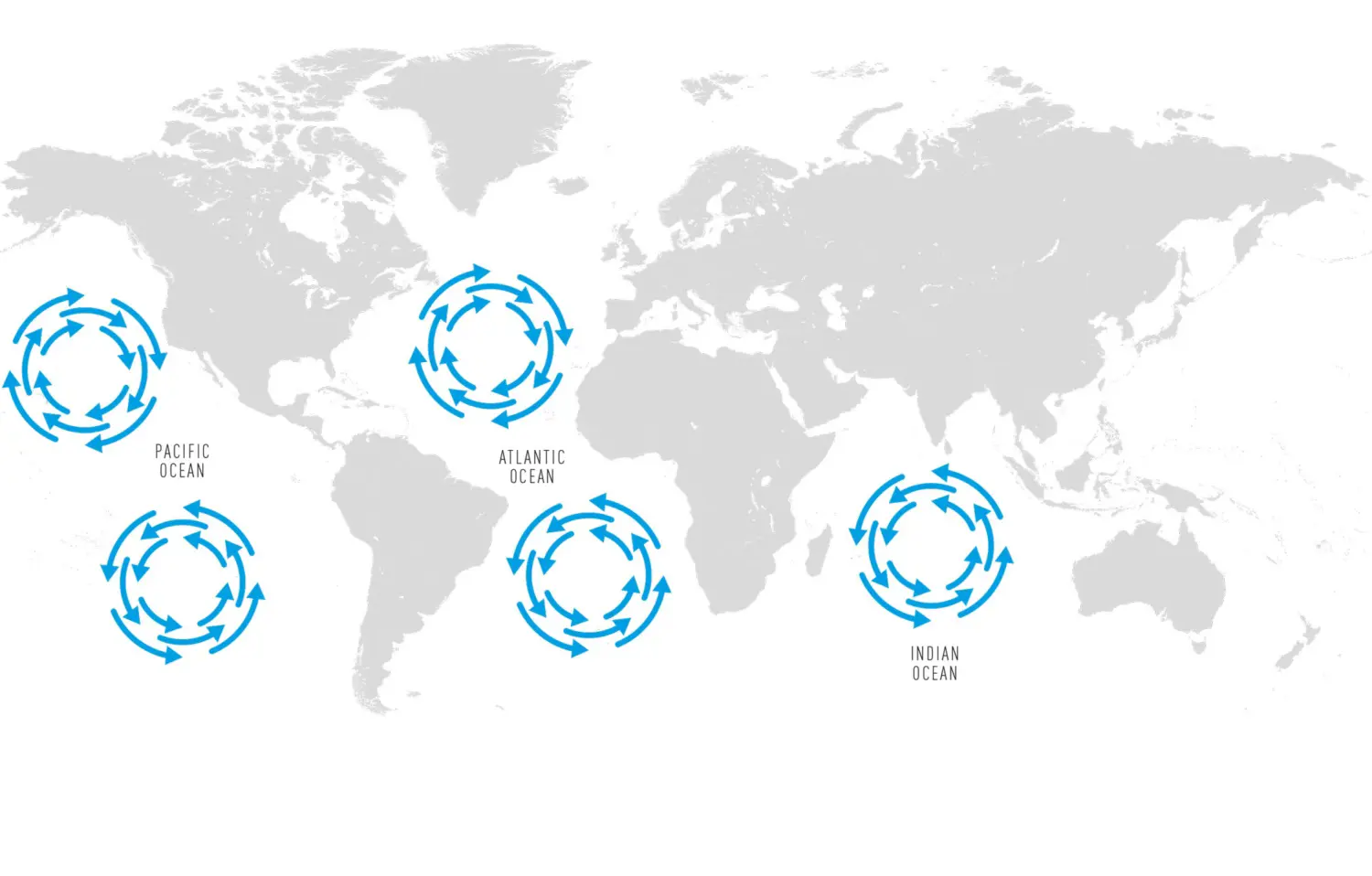
The oceans are constantly moving due to the rotation of the earth and the prevailing winds. There are five large rotating ocean currents, called gyres. Gyres in the oceans are a kind of giant whirlpool in which floating waste is slowly sucked into the middle, a bit like a shower drain. These gyres are in subtropical zones, above and below the equator. All five have an increased concentration of plastic waste compared to other parts of the oceans. The vast majority of these plastic particles can barely be seen with the naked eye because they are microplastics (smaller than five millimeters).
The gyres, however, do not feature floating islands of plastic, also called garbage patches. There is no visible floating mass of plastic waste in the middle of the ocean. Such misunderstandings persist, but pollution in the gyres is really an increased concentration of plastic that is, for the most part, in very small pieces.
Oceans hotspots : even more plastic than in gyres
There are many places in oceans and seas where the concentration of the plastic soup is even higher than in the gyres. These places are called hotspots. Plastic is concentrated there, but not as a result of circulating sea currents.
The Mediterranean Sea is such a hotspot. On the one hand, there is a continuous supply of plastic from rivers that flow into the Mediterranean and from coastal cities. On the other hand, the connection to the Atlantic Ocean is so narrow that little plastic escapes into the Atlantic. In other words: plastic that ends up in the Mediterranean Sea will also stay there.
Hotspots are places where high plastic concentrations occur for some reason. Apart from inland seas such as the Mediterranean (also the Black Sea or the Baltic Sea) these are:
- Bays with large cities.
- Bays where plastic floats in and remains.
- Places where rivers flow into the sea.
- Industrial centers and landfill sites situated on the coast.
- Places or islands where different ocean currents meet.
Donate and make a difference
Science is at the forefront of everything wedo. We work closely with universities and want to keep you up to date with the latest knowledge and developments. For this we also need your support, help us by making a donation!


_(1).png)