

Author: Dr. Heather Leslie is an independent scientist specializing in plastics and chemicals, with a consulting firm in Amsterdam. She is also a Science Consultant at the Plastic Soup Foundation. More info: www.heather-leslie.com
Even I am surprised to hear myself say this, after years of proclaiming things like, ‘Environmental problems cannot be solved without strict legislation’. Now I say: It does not matter whether we continue to outsource plastic regulations and policies to national or undemocratic supranational organisations. ‘Vintage organisations’ such as the UN are simply not the ones to lead us to a better future.
The summit that failed
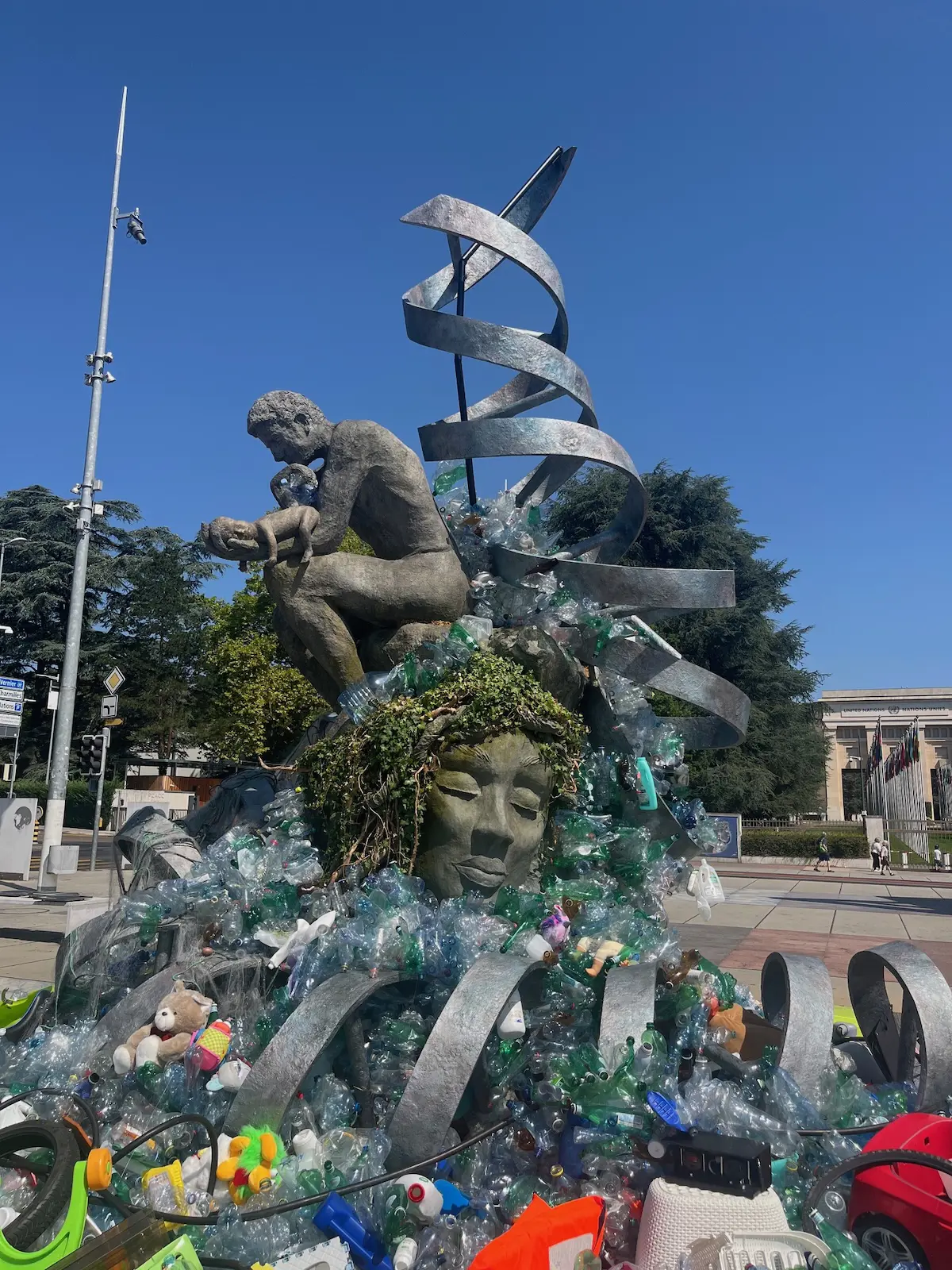
UN member states began negotiations in 2022 for a global, legally binding treaty against plastic pollution. In August, negotiations by the Intergovernmental Negotiating Committee on Plastic Pollution (INC 5.2) in Geneva failed. The 183 participating countries were unable to agree on the fundamental provisions that would protect people and the environment.
See also www.unep.org/inc-plastic-pollution
When the INC5 negotiations in Geneva at the Plastic Summit in August broke down, I was not particularly saddened. Even though I felt sorry for the participants who had fought hard for a global consensus and who were disappointed that it had come to nothing. I knew that there was a large group of people, spread across the globe, who did not have the patience to wait for international negotiations. They quietly continued with what they were already doing: creating the healthier, more balanced life they want. Individuals, together with like-minded communities and sometimes an inventive local authority. Step by step, with pleasure, and without the approval of international politics.
The structure of the plastic problem hung like a black cloud over the UN negotiations. Social science research has repeatedly concluded that “wicked problems” riddled with complexity, competing interests and a lack of clear solutions can expect little success from transnational multi-stakeholder partnerships.
INC5 participants have seen with their own eyes how such a multi-stakeholder experiment plays out in practice. But all is not lost. The efforts of stakeholders have at least generated publicity and awareness. There was considerable networking in both pro-environment and pro-plastic camps. Producers will continue to sell more than 700 billion dollars' worth of plastic in 2025. The legal frameworks allow for all of this, and growth is institutionally encouraged. According to Eunomia-QUNO research, governments worldwide distributed 43 billion dollars in subsidies to the plastics industry in 2024. Environmental scientists continue to provide evidence of the negative effects of pollution, despite shrinking research budgets.
What constitutes “sufficient research”?
The data does not lie. Public health and the environment are being destroyed. From the plastic in every bloodstream, on every beach and in every ditch, to the toxic chemical sauce that always accompanies plastic. Additives, monomers, catalysts, heavy metals, fillers and impurities; they all enter the living environment when plastic items and packaging are purchased. The PlastChem Project already summarised this last year: 4,200 of the 16,000 substances in contemporary plastics are substances of concern.
According to the group of scientists involved in the recently launched “Lancet Countdown on health and plastics”, there is already 8,000 Mt of plastic waste on Earth. Every year, we incur approximately 1.5 trillion dollars in health-related economic damage caused by plastic exposure. This kind of information has little influence on the players who want to increase plastic production. In 30 years' time, the industry hopes to produce two to three times more plastic than it does now.
For years, my colleagues and I have been determining the levels of such chemicals in nature and in humans: the chemical mixtures and microplastics from plastic products are reflected in both environmental and human samples. The individual substances do not even need to be present in high concentrations to be harmful, due to mixture toxicity and endocrine disruption at low concentrations. It is not unusual to find hundreds of hazardous substances in a single plastic material. The sum total is enough to render invertebrates unconscious, inflame tissues, disrupt hormones, impair the central nervous system, cause birth defects, or damage DNA. Our bodies are constantly working to repair the damage.
New experiments
A while ago, I was looking for other possible angles in the fight for justice and balance with regard to plastic, chemicals, health and the environment. Plastic manufacturers have knowledge, money and PR teams, and are among the most successful polluters on earth. You can engage in dialogue with them, but they are not allowed to change course. If a company profits from the system, it will not be the driving force behind a paradigm shift. But can the environment win without a fight? As the American architect, designer and poet Buckminster Fuller once put it: ‘You never change anything by fighting the existing reality. To change something, build a new model that makes the existing model obsolete.’
This idea ties in with the notion that a better world starts with yourself. Some people dispute this, but it seems to be a piece of wisdom that has stood the test of time. A better world never starts with the government. It always starts with imagination, a vision that entrenched issues can change and that something different is possible. I am thinking here of Another Science is Possible by the Belgian philosopher Isabel Stengers, and the importance of imaginative engagement, intuition and intention among scientists. As a philosopher, she wants to “activate the possible” in us (rather than merely describing the probable). It is a powerful perspective on the status quo. What if you start to imagine what the world you want to live in looks like, what you wear, who is there, what kind of work you do, how you travel, what you eat? Is there music, how much time do you spend with your family, etc.? That is a starting point. From there, you can always see whether a particular plastic application contributes to that vision.
No is a word of resistance
The good news is that anyone who wants to say “no” to unnecessary plastic has the opportunity to do so several times a day. Every time they don't buy synthetic plastic tea bags, cutlery, fast fashion, fast toys, sunscreen, plastic-coated paper, and vegetables in plastic bags or any of the millions of other plastic products they didn't really need or want in the first place it's a step towards systemic change.
When people do this, they become curious about knowledge. They start reading labels. They make more conscious choices. They avoid processed foods and often cook with fresh ingredients. They wear cotton more often than polyester and no longer use creams with 25 ingredients. In their homes, they are more likely to choose natural paints, natural fibre carpets and fabrics. They filter their drinking water. Food is reheated in a stainless steel pan instead of plastic containers in the microwave. They do not buy takeaway tea in a polyethylene cup with a nylon tea bag that releases 100,000 nanoplastic particles into your tea. They discover loose tea and allow themselves the luxury of sipping from an aesthetic, ergonomic cup.
There is no panic among this group; there are no barricades and usually no flags, but there is authenticity. Small steps, with each subsequent step leading to even more new possibilities. At home, at work and in the community, conscious people find each other. I have come to the conclusion that direct action at home and energy spent locally have an impact. I want to experiment more with self-reliance at the local level and wait less to see what international politics can achieve. Working locally is creative, educational, constructive; it produces immediate results, which makes it enjoyable. I would not be surprised if a lot of ordinary people are already changing the world.
Nuts online
- Miles, E.L. e.a. 2001. Environmental regime effectiveness: Confronting theory with evidence. Cambridge: The MIT Press
- EUNOMIA en QUNO 2025. Plastic Money: Turning Off the Subsidies Tap Phase 3 – Briefing Note for INC 5.2, 14 blz
- Monclús, L. e.a. 2025. Mapping the chemical complexity of plastics. Nature 643, 349–355 https://plastchem-project.org/
- Landrigan, Philip J. e.a. 2025. The Lancet Countdown on health and plastics. The Lancet 406, 10507, 1044–1062
This article was previously published in the magazine Milieu in november 2025.


_(1).png)
.png?version=18977&width=600)
.png?version=18582&width=600)
.png?version=18623&width=600)