

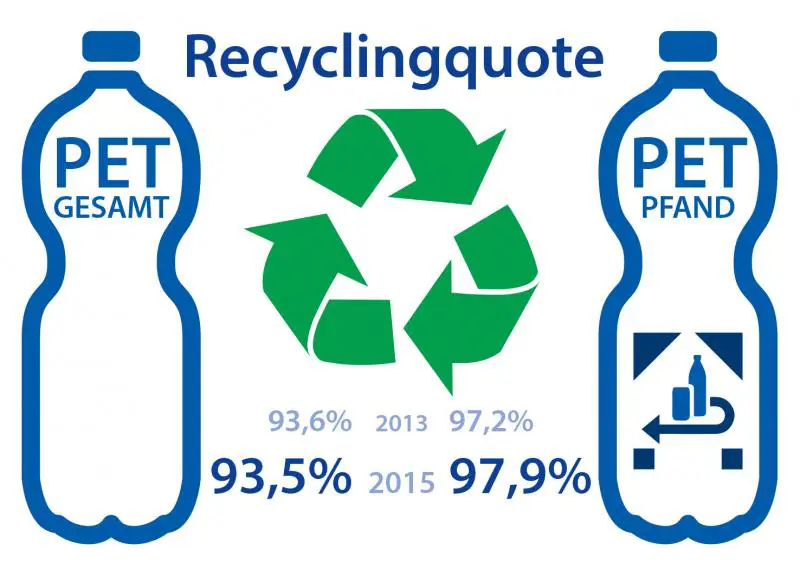
In Germany, all PET bottles have a deposit, while in the Netherlands only large bottles do. The German Association for Packaging Market Research (Gesellschaft für Verpackungsmarktforschung, GVM) has released a new study on the recycling of PET bottles, incorporating results up to 2015.
Unlike in the Netherlands, there is also a deposit on small 0.5-liter PET bottles in Germany. These are the bottles often used outdoors and frequently end up as litter in the Netherlands. The study notes that “although 0.5-liter PET bottles are relatively used more often outdoors, their collection rate is only marginally lower due to the high deposit” [compared to other bottles with a deposit]. The so-called recycling rate for deposit bottles in Germany is at 97.9%. The remainder goes to residual waste in incineration facilities. Few bottles are found in the environment.
In bottle-to-bottle recycling, the material from old PET bottles is used to make new PET bottles. This is a great example of closing the loop or the Circular Economy. The German packaging industry has succeeded in increasing the percentage of PET recyclate used for new bottles, despite the fact that new or virgin material, due to low oil prices, competes more strongly with recyclate than it did a few years ago. It is the consumers who return used bottles, enabling the industry to have the material needed to create new bottles. Forum PET, the division of IK Kunststoffverpackungen, advises to continue with the deposit system based on this study.
How starkly does this contrast with the Netherlands? In our country, the packaging industry fiercely opposes the expansion of the deposit system to small PET bottles. Municipal projects are allowed to try to address litter under the label “Clean Reward,” as long as there is no mention of the D-word.


_(1).png)