

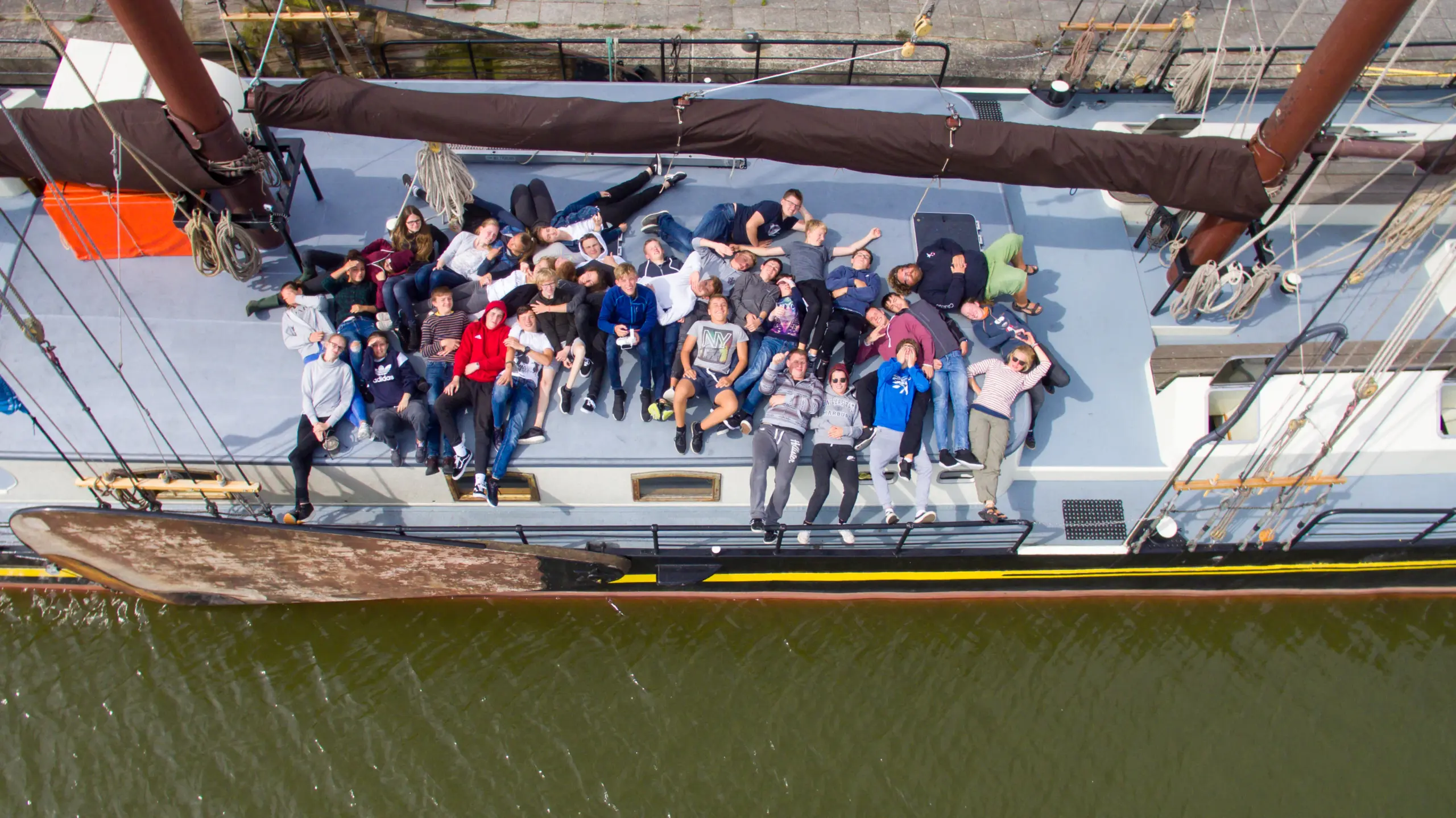
“Sailing on a large, authentic sailing ship is a fantastic experience and a sustainable outing in a beautiful setting. It’s special to experience the Netherlands from the water. In addition to historic port cities, there are stunning natural areas and lakes,” says Arjan van der Meer, managing director of NAUPAR. “But nature is under pressure, and we also want to raise awareness. Microplastics are a significant problem for both people and the environment. Therefore, we sought a partner who could provide ready-made educational materials for schools. Thanks to multiple sponsors, the Plastic Soup Foundation has developed extensive free educational materials that we can use.”
Free Educational Materials During Sailing Trips
Schools that rent one or more ships through NAUPAR can use this educational material for free. This also applies to German schools, as NAUPAR has had some lessons translated into German. “By sponsoring free educational materials about microplastics in the water, we want to add value for schools so they can access this valuable material without extra costs. The great thing about the materials is that they make a fantastic week on a ship even more educational. Plus, for teachers, it requires very little extra time since the entire package is ready to use,” explains Arjan.
Biology, Geography, Care: All Included in the 'Plastic Lessons'
Several lessons have been developed by the Plastic Soup Foundation in collaboration with GLOBE Netherlands. These include an introductory lesson on plastic pollution, a challenge to go on a plastic diet, and an in-depth lesson about microplastics in the water. The first two lessons are suitable for lower secondary education (vmbo-t, havo, and vwo), while the in-depth lesson is aimed at upper secondary students. The lessons engagingly cover biology, geography, care, and, in the in-depth lesson, Research & Design. In this lesson, students can take water samples and examine them for microplastics.
“At schools that have already conducted this last lesson, students made the shocking discovery that microplastics are indeed present everywhere in the water,” shares Wendela van Asbeck, Education Manager at Plastic Soup Foundation. This includes Dutch lakes, ditches, and the Wadden Sea. “We cannot remove the plastic that is already in the water, but we can tackle the problem at its source. This primarily means we need to stop the unnecessary use of single-use plastics.”
Global Annual Plastic Production: Over 440 Million Tons
Currently, more than 440 million tons of plastic are produced worldwide. This includes packaging materials, but plastic is also found in car tires, clothing, cosmetics, and personal care products. Approximately 3% of plastic ends up in the ocean. While that may not seem like much, it means that every minute, more than a truckload of plastic enters the oceans.
It would make a significant difference if less plastic were used as packaging. Additionally, using cars less would help, as wear and tear on tires releases microplastics into the air, similar to the shedding of fibers from clothing made of polyester, polyamide, acrylic, and elastane. Wearing and washing such clothing releases fibers that end up in the air or in water through washing machine runoff. “Currently, there are still few good alternatives to clothing made from plastic, so the most important thing now is to stop buying new clothes constantly. We need to move away from the idea that we need a new wardrobe every season,” Wendela explains.
The good news is that there is gradually increasing awareness of the microplastics problem. Politically, efforts are also being made globally to develop legislation and other measures to reduce plastic production and usage. However, there is still a long way to go. Raising awareness among the younger generation can help turn the tide, and lessons on this topic play a crucial role.


_(1).png)