

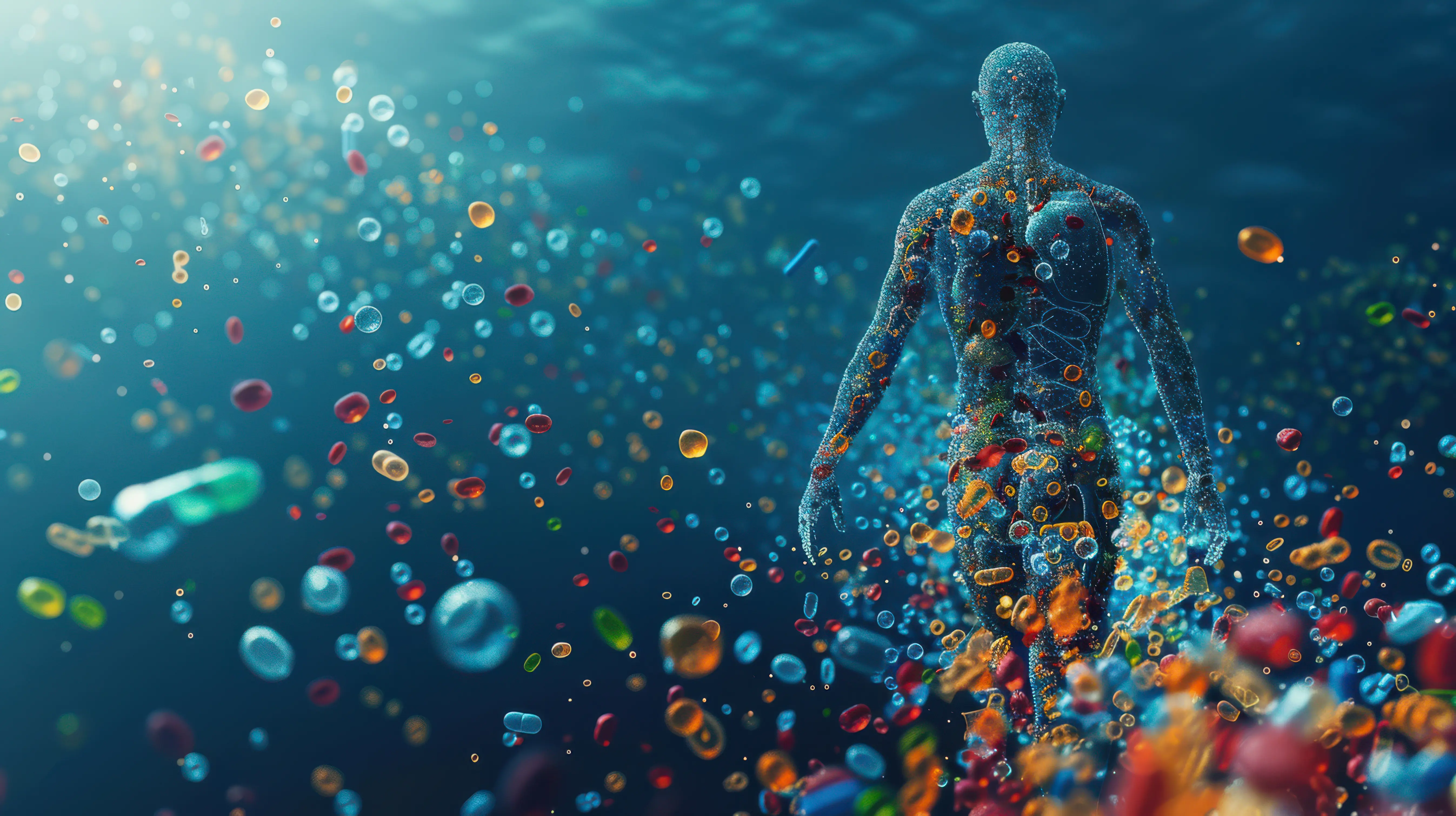
Brussels, 22 July 2026 — A new report, based on peer reviewed evidence and published by Plastic Soup Foundation in collaboration with Green Impact, found current EU legislation fails to prevent microplastics' spread in human blood, breast milk, lungs, brain tissue, placenta, and children's urine, and warns that microplastics and nanoplastics constitute an escalating public health crisis.
Maria Westerbos, Founder, Plastic Soup Foundation, said: "This evidence can no longer be treated as a marginal environmental issue: it is a public health emergency that the EU's 2024–2029 legislative cycle has a unique opportunity to address."
The report "Microplastics and Public Health: Acknowledged Risks and EU Policy Action" (report also available here) is published ahead of the informal meeting of EU Environment Ministers in Dublin on 23–24 July. Ministers will discuss the EU's long-term climate and environmental priorities, including the upcoming Circular Economy Act, a key piece of legislation to tackle microplastic pollution at its source. Plastic Soup Foundation and Green Impact are calling on ministers to ensure the health impacts of microplastics are at the heart of these discussions.
The study finds that while the EU has taken meaningful first steps, including the 2023 REACH restriction on intentionally added microplastics and the proposed pellet loss regulation, major regulatory gaps remain: inconsistent detection standards for particles under 300 microns, long transition periods and exemptions under REACH, no explicit provisions addressing secondary microplastics generated from the degradation of larger plastic waste, and uneven enforcement across Member States.
Gaia Angelini, President of Green Impact said: "Europe has the scientific evidence and holds the political mandate to protect public health. What is missing is the ambition to legislate at the pace the science demands."
Micro- and nanoplastics act as vectors for toxic substances, including endocrine disruptors, heavy metals, persistent organic pollutants, and antibiotic resistance genes, entering the body through ingestion, inhalation, and dermal contact. Documented effects range from inflammation and oxidative stress to neurotoxicity, reproductive harm, developmental disorders, and carcinogenicity. Children, pregnant women, and frontline communities face disproportionate risk.
Leading scientists cited in the report describe the scale of the threat in stark terms. Professor Shanna Swan (Icahn School of Medicine at Mount Sinai) states that plastics in daily life are "threatening our survival as a species," pointing to a sharp acceleration in the decline of sperm counts since 2000. Professor Thais Mauad (University of São Paulo), whose team was first to demonstrate microplastics reaching the human brain, calls the findings "very disturbing" given the brain's role as the body's most protected organ. Professor Lukas Kenner (Medical University of Vienna) warns that microplastics can cross the placental barrier, with unborn children absorbing the highest particle loads, raising concerns over early-onset cancer risk.
The report is published under the European Forum on Microplastics and Health (2025–2029), an informal discussion forum bridging policy with science, established by members of the European Parliament (MEPs) to advance science-based solutions to the health impacts of microplastics, in line with the Global Plastic Treaty process. The Forum brings together policymakers, researchers, investors, industry, and innovators, and will hold an in-person event with MEPs, experts, and innovators at the European Parliament in September 2026.
Plastic Soup Foundation and Green Impact call on EU policymakers to embed microplastic prevention in the forthcoming Circular Economy Act, including reformed:
• Extended Producer Responsibility schemes covering a product's full lifecycle, not just its end-of-life.
• Ensure the Chemicals Industry Action Plan includes fiscal incentives to accelerate substitution of hazardous, persistent polymers.
• Adopt binding microfibre-shedding standards for textiles under the Ecodesign for Sustainable Products Regulation by 2027.
• Treat microplastics as a priority pollutant under the Water Resilience Strategy and the revision of the Water Framework Directive.
• Secure a legally binding mandate on microplastics in the Global Plastic Treaty negotiations.
• Scale up research funding for cross-disciplinary health-environment microplastics research under the post-2027 Multiannual Financial Framework.
Contact: Luisa Colasimone, communication Green Impact | lglcolasimone@gmail.com
Maria Westerbos, Founder, Plastic Soup Foundation, said: "This evidence can no longer be treated as a marginal environmental issue: it is a public health emergency that the EU's 2024–2029 legislative cycle has a unique opportunity to address."
The report "Microplastics and Public Health: Acknowledged Risks and EU Policy Action" (report also available here) is published ahead of the informal meeting of EU Environment Ministers in Dublin on 23–24 July. Ministers will discuss the EU's long-term climate and environmental priorities, including the upcoming Circular Economy Act, a key piece of legislation to tackle microplastic pollution at its source. Plastic Soup Foundation and Green Impact are calling on ministers to ensure the health impacts of microplastics are at the heart of these discussions.
The study finds that while the EU has taken meaningful first steps, including the 2023 REACH restriction on intentionally added microplastics and the proposed pellet loss regulation, major regulatory gaps remain: inconsistent detection standards for particles under 300 microns, long transition periods and exemptions under REACH, no explicit provisions addressing secondary microplastics generated from the degradation of larger plastic waste, and uneven enforcement across Member States.
Gaia Angelini, President of Green Impact said: "Europe has the scientific evidence and holds the political mandate to protect public health. What is missing is the ambition to legislate at the pace the science demands."
Micro- and nanoplastics act as vectors for toxic substances, including endocrine disruptors, heavy metals, persistent organic pollutants, and antibiotic resistance genes, entering the body through ingestion, inhalation, and dermal contact. Documented effects range from inflammation and oxidative stress to neurotoxicity, reproductive harm, developmental disorders, and carcinogenicity. Children, pregnant women, and frontline communities face disproportionate risk.
Leading scientists cited in the report describe the scale of the threat in stark terms. Professor Shanna Swan (Icahn School of Medicine at Mount Sinai) states that plastics in daily life are "threatening our survival as a species," pointing to a sharp acceleration in the decline of sperm counts since 2000. Professor Thais Mauad (University of São Paulo), whose team was first to demonstrate microplastics reaching the human brain, calls the findings "very disturbing" given the brain's role as the body's most protected organ. Professor Lukas Kenner (Medical University of Vienna) warns that microplastics can cross the placental barrier, with unborn children absorbing the highest particle loads, raising concerns over early-onset cancer risk.
The report is published under the European Forum on Microplastics and Health (2025–2029), an informal discussion forum bridging policy with science, established by members of the European Parliament (MEPs) to advance science-based solutions to the health impacts of microplastics, in line with the Global Plastic Treaty process. The Forum brings together policymakers, researchers, investors, industry, and innovators, and will hold an in-person event with MEPs, experts, and innovators at the European Parliament in September 2026.
Plastic Soup Foundation and Green Impact call on EU policymakers to embed microplastic prevention in the forthcoming Circular Economy Act, including reformed:
• Extended Producer Responsibility schemes covering a product's full lifecycle, not just its end-of-life.
• Ensure the Chemicals Industry Action Plan includes fiscal incentives to accelerate substitution of hazardous, persistent polymers.
• Adopt binding microfibre-shedding standards for textiles under the Ecodesign for Sustainable Products Regulation by 2027.
• Treat microplastics as a priority pollutant under the Water Resilience Strategy and the revision of the Water Framework Directive.
• Secure a legally binding mandate on microplastics in the Global Plastic Treaty negotiations.
• Scale up research funding for cross-disciplinary health-environment microplastics research under the post-2027 Multiannual Financial Framework.
Contact: Luisa Colasimone, communication Green Impact | lglcolasimone@gmail.com


.png)